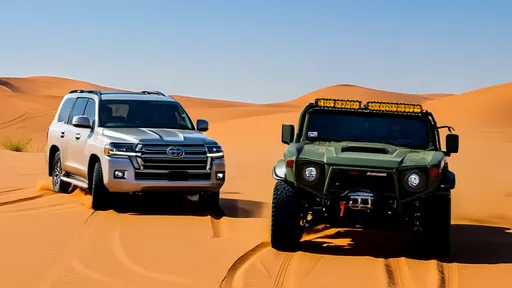
The vast, undulating dunes of Dubai have long been a playground for thrill-seekers and off-road enthusiasts. Among the most iconic vehicles to tackle these golden waves are the Toyota Land Cruiser and the Hummer, each offering a distinctly different experience when it comes to dune bashing. The choice between these two giants isn’t just about preference—it’s about understanding how each machine interacts with the desert, and how that interaction shapes the adventure.
The Toyota Land Cruiser is a legend in its own right, a vehicle synonymous with reliability and rugged capability. When it comes to Dubai’s dunes, the Land Cruiser delivers a surprisingly smooth ride, its suspension expertly absorbing the shocks of rapid ascents and sudden drops. The steering feels precise, allowing drivers to carve through the sand with a sense of control that borders on intuitive. There’s a reason why local desert guides often favor this vehicle—it’s built to endure the harsh conditions while keeping occupants comfortable. The engine, though not the most powerful in its class, provides steady torque that’s perfect for maintaining momentum up steep inclines. For those who prefer a balance between excitement and stability, the Land Cruiser is an ideal companion.
In contrast, the Hummer is a beast of a different nature. Its sheer size and weight make it an imposing presence on the dunes, and its performance reflects that. Where the Land Cruiser glides, the Hummer charges. The ride is noticeably more aggressive, with every bump and crest felt more intensely inside the cabin. This isn’t necessarily a drawback—for adrenaline junkies, the raw, unfiltered feedback from the terrain only amplifies the thrill. The Hummer’s powerful engine roars as it conquers dunes that would make lesser vehicles hesitate, and its wide stance provides a sense of invincibility. However, this comes at the cost of maneuverability; the Hummer doesn’t turn as sharply as the Land Cruiser, requiring a more deliberate driving style.
One of the most striking differences between the two is how they handle the desert’s unpredictability. The Land Cruiser’s lighter frame and responsive handling make it better suited for quick adjustments when the sand shifts unexpectedly. It’s the kind of vehicle that forgives minor mistakes, allowing drivers to recover smoothly from near-slips or misjudged angles. The Hummer, on the other hand, demands respect. Its weight can work against it in softer sand, where it’s more prone to sinking if not driven with confidence. Yet, when handled correctly, it plows through obstacles with an almost brutal efficiency, making it the preferred choice for those who want to feel the desert’s challenges in their purest form.
Comfort is another area where these vehicles diverge. The Land Cruiser’s interior is designed with long journeys in mind, offering plush seating and a quieter cabin. Even during intense dune bashing sessions, passengers often find themselves less fatigued, thanks to the vehicle’s ability to dampen the harshest impacts. The Hummer, while spacious, trades some of that refinement for ruggedness. The noise levels are higher, and the ride is less insulated from the terrain—a trade-off that many enthusiasts are willing to accept for the sake of authenticity. It’s the difference between riding in a luxury SUV that happens to excel off-road and riding in a machine that feels like it was born in the dunes.
Ultimately, the choice between a Toyota Land Cruiser and a Hummer for Dubai’s dune bashing comes down to what kind of experience you’re seeking. The Land Cruiser offers a polished, controlled adventure, where skill and machine work in harmony to tame the desert. The Hummer, meanwhile, is for those who want to wrestle with the elements, to feel every grain of sand beneath them as they power through the landscape. Both are incredible in their own ways, and both will leave you with memories of Dubai’s deserts that last a lifetime.

By /Jul 25, 2025

By /Jul 25, 2025

By /Jul 25, 2025

By /Jul 25, 2025

By /Jul 25, 2025

By /Jul 25, 2025

By /Jul 25, 2025

By /Jul 25, 2025

By /Jul 25, 2025

By /Jul 25, 2025

By /Jul 25, 2025

By /Jul 25, 2025
By /Jul 25, 2025

By /Jul 25, 2025

By /Jul 25, 2025

By /Jul 25, 2025

By /Jul 25, 2025

By /Jul 25, 2025

By /Jul 25, 2025

By /Jul 25, 2025
