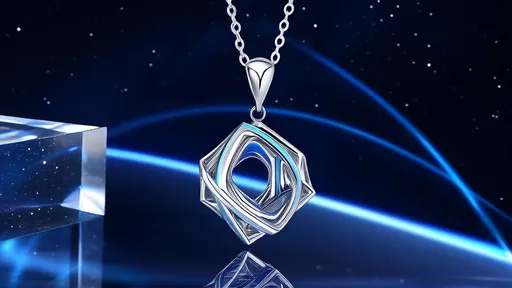
In an era where technology and fashion increasingly intersect, a groundbreaking innovation has emerged that bridges the gap between science and style. Magnetic field-responsive jewelry that changes color based on Earth's latitude and longitude represents not just a fashion statement, but a wearable piece of geolocative art. These pieces don’t just adorn the body—they interact with the planet itself, creating a dynamic relationship between wearer and environment.
The concept behind these pieces hinges on advanced materials science. Tiny sensors embedded within the jewelry detect subtle shifts in the Earth’s magnetic field, which vary depending on geographic location. These sensors trigger color-changing elements—often liquid crystals or thermochromic pigments—that respond to the magnetic fluctuations. The result is jewelry that shifts hues as you travel, creating a visual representation of your journey across the globe.
What makes this technology particularly fascinating is its blend of precision and artistry. The jewelry doesn’t merely react to broad changes in location; it responds to the specific magnetic signature of each latitude and longitude. A piece worn in the magnetic intensity of the Arctic Circle might display deep blues and purples, while the same piece in equatorial regions could shimmer with warm reds and oranges. This creates a deeply personal connection to place, as no two locations produce exactly the same chromatic response.
The implications extend beyond mere aesthetics. For travelers, these pieces serve as a tangible record of their voyages, with each color shift marking a new destination. Scientists and researchers working in remote locations could use them as subtle indicators of magnetic field variations. There’s even potential for emotional resonance—imagine a piece that gradually changes color as a loved one travels farther away, serving as a poetic reminder of distance and connection.
From a technical standpoint, the development of these pieces required solving significant engineering challenges. Early prototypes struggled with sensitivity—either failing to detect subtle magnetic variations or overreacting to minor fluctuations. The breakthrough came with the integration of nano-engineered magnetic alloys that provide both precision and stability. These materials, often derived from aerospace technology, allow the jewelry to maintain accuracy while remaining lightweight and wearable.
The aesthetic possibilities are nearly limitless. Some designers have created minimalist pieces where the color change is subtle, appearing almost like a natural patina. Others have embraced bold, dramatic transformations where entire sections of a necklace or bracelet shift between complementary colors. There’s particular excitement around pieces that incorporate multiple responsive elements, creating intricate patterns that evolve throughout a journey.
As with any emerging technology, questions about practicality arise. How does the jewelry handle sudden magnetic disturbances, like those near electronic devices? Designers assure that sophisticated filtering algorithms distinguish between Earth’s natural magnetic field and artificial interference. What about battery life? Many pieces employ energy-harvesting technology, drawing power from motion or temperature differences to sustain their sensors indefinitely.
The cultural significance of this innovation shouldn’t be overlooked. Throughout history, jewelry has served as a marker of identity, status, and personal narrative. These magnetic field-responsive pieces represent a contemporary evolution of that tradition, where the story being told isn’t just about the wearer, but about their relationship to the planet. In an age of increasing digital detachment, they offer a physical, tactile connection to the Earth’s invisible forces.
Looking ahead, the potential applications continue to expand. Some visionaries speculate about jewelry that responds not just to location, but to solar activity or lunar cycles. Others imagine pieces that communicate with smartphones to log travel histories or share color patterns with loved ones. The intersection of fashion and geotechnology appears ripe with possibilities waiting to be explored.
For now, these magnetic field-responsive pieces remain at the forefront of wearable technology. They challenge our conventional notions of what jewelry can be, transforming passive adornment into an active dialogue between human and planet. As the technology matures and becomes more accessible, we may find ourselves wearing not just accessories, but portable, personal interpretations of the Earth itself.

By /Jul 25, 2025
By /Jul 25, 2025

By /Jul 25, 2025

By /Jul 25, 2025

By /Jul 25, 2025
By /Jul 25, 2025

By /Jul 25, 2025

By /Jul 25, 2025

By /Jul 25, 2025

By /Jul 25, 2025

By /Jul 25, 2025

By /Jul 25, 2025

By /Jul 25, 2025

By /Jul 25, 2025

By /Jul 25, 2025

By /Jul 25, 2025

By /Jul 25, 2025

By /Jul 25, 2025
By /Jul 25, 2025
By /Jul 25, 2025
